
By: Estefania Marti & Jedaja van Kempen
April, 20th 2026
True Pricing and True Cost Accounting (TCA) of food continue to emerge as key approaches to measure the hidden costs (and benefits) of our food production and consumption. Over the last 10+ years there has been increasing momentum in Europe and the United States, with key studies and publications, contrasted with limited attention in low- and middle-income settings. This started to change quickly with the consecutive publications (2023 & 2024) on this topic by the Food and Agriculture Organization (FAO).
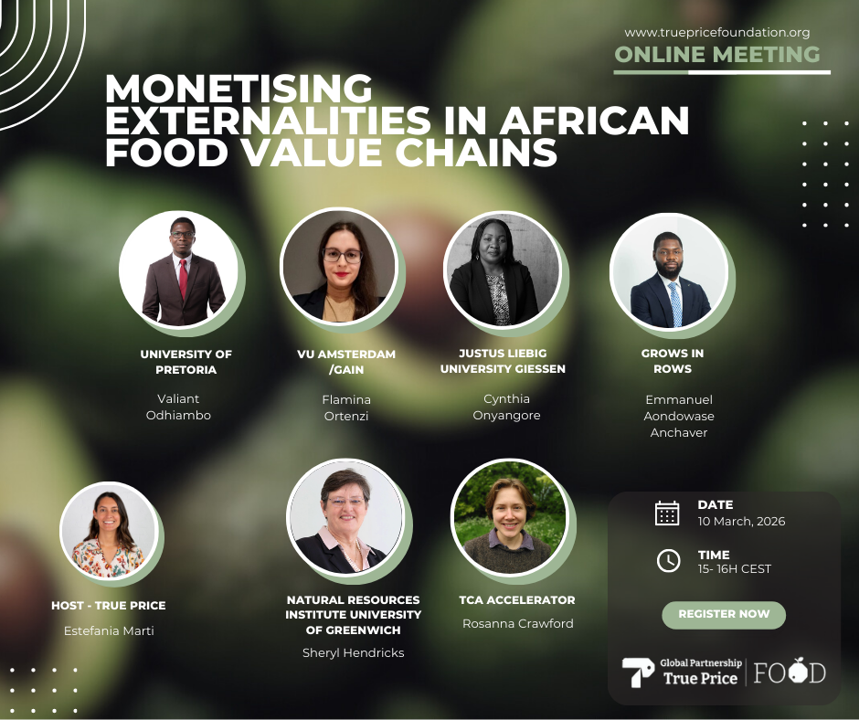
This gap was explored during our last online Global Partnership on the True Price of Food (GPTPF) member meeting, organized by True Price Foundation and Netherlands Food Partnership (NFP), on March 10th. We heard reflections from an expert on this topic and one of the lead authors on the first study on the True Costs of the global food system, Professor Sheryl Hendriks. Professor Hendriks notes: ‘There’s quite a lot of debate in the community around comparability, standardisation, and harmonisation of different methodologies. I would caution about closing the door too quickly because I think this is still a very much growing domain.’
The challenge is that, because the academic field of true pricing and true cost accounting is so new, there are a lot of people using slightly differing quantification and monetisation methods. While this absence of standardization might bring with it its own set of problems, it does support new depths of ‘ingenuity and innovation’ according to Professor Hendriks.
This tension between diversity and comparability is reflected in the work presented by Flaminia Ortenzi (Netherlands Food Partnership, GAIN, True Price, ATNI). She presented the results of a three-part review series on true cost accounting (TCA) methods, covering environmental, health, and socio-economic impact. While the field is rapidly growing, there is a high level of methodological diversity and limited standardization, which makes comparisons across studies difficult. Flaminia also talked about key gaps, including a strong focus on high-income countries and protein foods, and a lack of data in low- and middle-income contexts. The findings underline the need for more harmonized, inclusive, and holistic approaches to better support the application of TCA in transforming food systems.
This raises an important question: how should we apply true pricing in practice when the academic debate is ongoing, the field continues to develop, and in many cases does not translate calculations into concrete recommendations?
During the second half of the GPTPG meeting, two case studies help to shift our focus to implementation in real-world food systems, highlighting how the importance of diversity in the field as outlined by Professor Sheryl plays out in practice.
Valiant Odhiambo presented a case study applying TCA methods to the green bean value chain in Kenya. International trade demand for green beans has led to increased production, which in turn has generated negative externalities. The study shows that external costs in the chain are primarily concentrated at the production stage, driven by farming practices such as fertilizer use, pesticides, and irrigation.
Across the green bean value chain, environmental externalities make up the largest share of external costs, followed by social impacts such as living income gaps and child labour, and health impacts linked to pesticides and air pollution. Total hidden costs were estimated at 124.03 million USD (range 115.93–132.20), at least twice the market value of green beans, and when scaled to national production levels, these costs significantly surpassed both market and export values.
The study also explored internalisation options through stakeholder engagement, identifying financial incentives, regulation, and voluntary measures as key pathways. Findings suggest that while economic instruments are important, behavioural, institutional, and governance factors strongly influence stakeholder willingness to adopt change.
The second case study brings us from green beans to avocados. While the green bean case demonstrates the power of quantified research, it also raises questions about how these methods translate into less structured contexts. Emmanuel Anchaver from Grows in Rows explored how true cost accounting operates in practice within largely informal and data-limited production systems.
Grows in Rows, together with True Price, conducted a pilot applying true cost accounting in Nigeria’s avocado value chain. The case study reveals that avocado production in southern Kaduna is predominantly smallholder-based, informally organised, and not yet integrated into formal measurement or pricing systems. The full results will be published soon, but one key insight already stands out: while data limitations and lack of formal records make full quantification challenging, this context also offers an opportunity. Because the value chain is still developing, TCA can be used as an early-stage diagnostic and design tool rather than only a retrospective accounting method.
Across both case studies, a number of shared challenges emerge. While TCA provides valuable insights into hidden external costs, data availability and methodological comparability remain significant issues. Translating research insights into action is equally challenging, stakeholder behaviour, policy implementation, and market dynamics all influence whether true pricing can lead to meaningful change. This is exactly why the GPTPF exists: to support food system actors in piloting, implementing, and using true pricing and true cost accounting tools with integrity, and to enable a network to share learnings and inspire action.
A big thank you to all speakers and participants for their contributions. For any questions, feel free to reach out to globalpartnership@trueprice.org or to estefania@trueprice.org.
We invite you to join the Global Partnership on the True Price of Food community Join here.